

Establish Data Governance as your
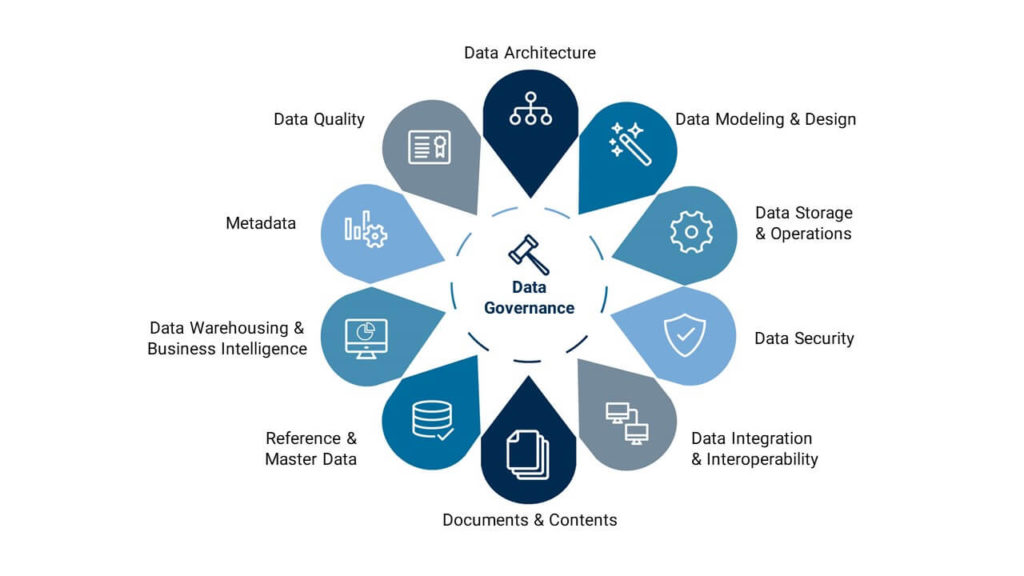
Every company gathers and stores an enormous amount of data every day. Quantity alone is not enough when it comes to using this data as a strategic resource within your company. You need to generate knowledge from this data so that your company can act based on data-driven decisions. The key to success is a central Data Governance you can use to define rules, processes and those responsible for your data management. You then need to make sure this data is available to your employees. Data democratization can help make your employees data literate.
Data Orientation for your Company
Successfully establishing Data Governance and data literacy leads to assurance of data quality so that you can make sense of your data. We recommend a structured meta data management and stable information architecture so that your company can react quickly and reliably when it comes to change. A well thought out strategic concept can make you the master of the following central challenges.
Step-by-Step Towards a Data-Oriented Company
You can’t just simply collect data and expect this to make you a data-driven company. You need to systematically use the data to be able to derive strategic decisions. We guide you following one approach to provide sustainability. We will help you down your individual path to becoming a data-oriented company – from definition right through to establishing a cultural change.
7 Steps to a Data-Driven Company
We will use 7 steps along the value chain to support you in uncovering hidden potential in your data and using it in a sustainable manner. Our focus is on ranking and evaluating the single steps to your individual needs and then finding a way of implementing them within your company; we know: your company and your data are unique. Only your individual road map can achieve your goals.

How we support you
We offer an extensive portfolio of services to help your company become data-oriented. Our experienced data consultants will answer any data-based questions you may have and lead you from creation of a company-wide concept, right the way through to implementation, including technical implementation. Our powerful data modeling tool, Innovator, can also be employed for this.
Maximize the Value of your Data with Customized Analytics & AI
Have you got huge data sets you aren’t putting to good use? Then you’ve come to the right place! Our data analytics & AI help you to unlock the full potential of your company data. We provide you with customized solutions, from strategic consulting, data analysis and visualization, right the way through to artificial intelligence, machine learning, text mining & LLMs, not forgetting decision intelligence and predictive maintenance. It doesn’t matter whether you have CRM, ERP or unstructured text data: We can integrate and analyze data from practically any source and put the results into interactive dashboards for you. Purging and harmonizing guarantees you the highest level of data quality. Find out how you can make data-driven decisions in your company!
Establishing Data Governance in your Company
Data Governance forms the basis of successful data orientation and enables data to be understood by everyone within your company. Profit from our many years of experience and our customer-specific approach when it comes to drafting your Data Governance. As data experts, we know all the obstacles to watch out for when it comes to establishing a successful Data Governance. We provide comprehensive support, from designing a concept right the way through to technical implementation and programming individual steps. We would be happy to help you to embed a common understanding for data within the mindset of your employees and increase their data literacy.
Building a Company-Wide Meta Data Management
We use existing systems to help you to build a sustainable Meta Data Management. Together we will create a tailor-made data catalog containing all meta data about reports, key figures and data provision to be employed throughout your company. We will take your individual requirements into consideration when helping you select a suitable data cataloging tool and implementing it successfully within your company.
Traceability of Data Stores
Data lineage starts with taking stock of existing operative systems, as well as including disparate systems (Data Warehouse and Data Lake). Your company's value chain and data structures will become transparent and traceable and can be easily documented. Data graveyards will be uncovered and eliminated. You can easily and clearly display dependencies by taking a 360° look at your data. This will help you to easily recognize ways to optimize and speed up your processes.
Data Warehouse Design
We base our data structure design on your enterprise data modeling. We link your business rules with technical data structures to achieve a technical implementation and documentation of the process chain. This enables a long-lasting process chain which is not dependent on individual employees (Data Lineage), which in turn leads to complex processes being able to be customized and fulfillment of compliance requirements.
Data Warehouse Automation with Data Vault and Innovator
Thanks to its stringent approach, Data Vault is the perfect choice for agile and automated processes. Data lake data can be easily integrated; technical and business interests are clearly separated from one another. This makes Data Vault modeling scalable, flexible, consistent and customizable to the needs of the respective company using it. We would be happy to help you model your Data Warehouse using Data Vault. Our power tool, Innovator, is the perfect tool for the job. A Data Vault model can be partially automatically created in Innovator; your modeling decisions are used to automatically create a part of the model.
Innovator for Information Architects
Do you want a comprehensive overview of your company data? Then use Innovator to visualize your data flows and model your Data Warehouse with Data Vault 2.0. Link your data with your data model and merge it with respective applications and processes. Make your data visible and also demonstrate its value. Innovator also has an interface to the SAP Solution Manager.
MID in Action
Do you want to find out more about Data Governance, data literacy, meta data management and tool-supported implementation of data management? Then check out our exciting blog entries, success stories and posters all to do with this topic.
Current blog posts about Data
In our blog you’ll regularly find new articles on trends, best practices and current challenges around Data. Dive into practical insights and get inspired by concrete examples from the world of data management!

Predictive Maintenance: From Model to Rollout | 3/3
In the first two parts of our predictive maintenance blog series, we explored the basics, challenges, use cases and key steps for preparing and analyzing data. With this foundation in place, we now turn to one of the most critical…

Predictive Maintenance: Data Preparation | 2/3
In the first part of our blog series, we explored the definition, challenges and use cases of predictive maintenance. We will now show you why careful data preparation is important when it comes to accurate and reliable predictions. Predictive maintenance…

Predictive Maintenance: The Future of Maintenance | 1/3
Predictive maintenance (PM) is a key tool for Industry 4.0, helping companies maximize their system’s efficiency and reduce unplanned downtime. PM enables precise maintenance planning and accurate estimation of a component’s remaining useful life (RUL). This enables you to proactively…

Data-Based Decisions thanks to Decision Intelligence | 3/3
We’ve already covered the basics of Business Data Analytics and data-driven process optimization in the first two parts of our blog series. Now we’re diving into Decision Intelligence. We’ll show you the three types of Decision Intelligence and how you…

Data-Driven Process Optimization: Getting Started | 2/3
In the first part of our blog series, we explained why business data analytics is becoming essential in everyday business and the opportunities it creates. Now we’ll give you an easy-to-follow guide you can use to put it all into…

What does Business Data Analytics Mean? | 1/3
Today’s business landscape is driven more than ever by data-based decision-making, spanning all industries and (specialized) departments. Companies from all sectors are increasingly aiming to generate intelligent insights from their data to help them make decisions. As a result, analyzed…
These Companies put their Trust in MID























FAQs about Data Management at MID
Data governance defines how data is managed, used and protected within your company. It establishes processes, rules and responsibilities to ensure that you always have access to high-quality, secure and reliable data. MID helps you establish efficient and sustainable data governance.
MID advises you on data structures, data formats and data integration. We help you implement the FAIR principle, avoid redundancies and provide tools and processes to ensure consistently high and traceable data quality, from migration right the way through to ongoing maintenance.
Data literacy is the ability to correctly understand and effectively use data. MID helps you establish data competency as part of your corporate culture through targeted workshops, training sessions and change programs, so that everyone in your team can handle data with confidence.
Meta data management creates transparency across all data sources, definitions and interfaces within your company. MID supports you in building a centralized data catalog, from tool selection right the way through to sustainable implementation; meaning you benefit long term from maximum traceability and simplified data analysis.
MID helps you transform your data foundation into value-driven analyses: We provide strategy consulting, customized data analyses and visualizations, AI integration, machine learning and predictive maintenance solutions. The results can be viewed in clear and easy to understand dashboards, allowing you to make data-driven decisions and help you identify new business opportunities early on.
MID supports you throughout the conception, design and implementation of your data warehouse, including modeling with data vault and using powerful tools such as Innovator. This provides you with a scalable and transparent data architecture for reporting, analytics and compliance.