
The Business Model Canvas, abbreviated BMC, is a central tool for visualizing and analyzing business models. The method was developed in 2004 by Alexander Osterwalder and his team, with the goal of designing business models in an innovative and, above all, collaborative way.
Especially for startups, the BMC offers a simple and flexible alternative compared to traditional business plans. It is ideal when business models need to be adjusted or further developed frequently. With the BMC you can quickly sketch new variants of your business model, discuss them directly with the team, and easily compare them with each other. This makes the Business Model Canvas the perfect tool to make the central building blocks of your business visible at a glance and to develop them flexibly.
The Business Model Canvas board contains nine areas on one page with the essential aspects of a business model:
- Customer Segments (CS)
- Value Propositions (VP) – customer value propositions to solve problems / meet needs
- Channels (CH) – channels for communication, distribution, sales
- Customer Relationships (CR) – customer relationships for each customer segment
- Revenue Streams (R$) – revenue streams from the value propositions
- Key Resources (KR)
- Key Activities (KA)
- Key Partnerships (KP)
- Cost Structure (C$)
Structure of the Business Model Canvas
Here is an example of a business model on this topic that is not quite so common: building igloos.
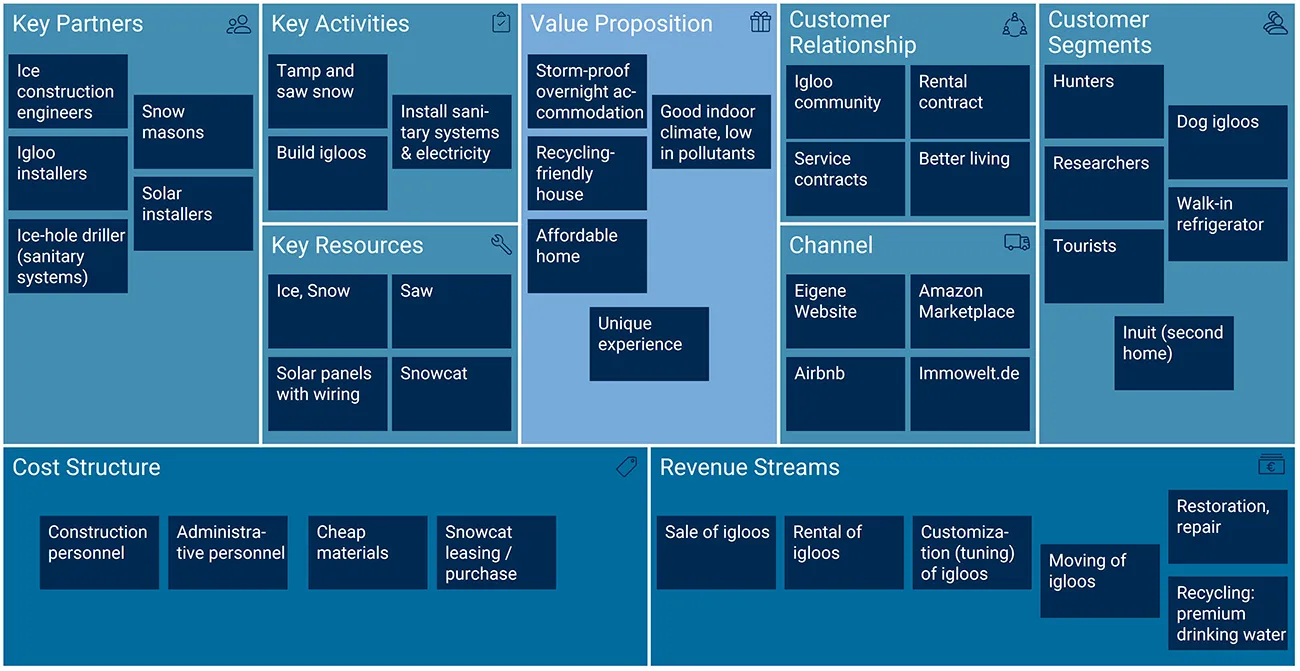
Procedure
There is no specific recommended order for developing a BMC. The individual elements are best developed and discussed in an interdisciplinary team and then placed into the appropriate areas.
Advantages
- Clear overview
- Easy to understand
- Good for collaborative group work
- The business model at a glance
If new elements are added or changed in one area, you can very easily see which other areas this change affects and adapt them accordingly.
Business plan
Why do I still need a detailed business plan?
A comprehensive business plan is often required to secure capital from investors, bank loans, or subsidies. In this case, you can use the Business Model Canvas as a preliminary step to creating your business plan. In many cases, for example, to further develop your internal corporate strategy, the BMC can often replace a business plan, which is much more time-consuming to create.
Summary
The BMC is a suitable tool when it comes to:
- Managing rapidly changing business models (startups)
- Translating business plans into business processes
- Developing new organizational structures
- Conveying a cross-team understanding of the business model and the roles of individual employees in it
- Playing through different variants of business models
- Conducting target-actual comparisons of business models
Further links
- The BMC developers’ website with videos and templates in English
- Introduction to BMC in German with videos, description of the content, and variants
Experience the Business Model Canvas in practice
Are you looking for a modeling tool with which you can implement the BMC directly? Try the Innovator Enterprise Modeling Suite now for 60 days free as a full version! Model business processes, databases, as well as software and enterprise architectures with just one software. Your trial already contains 3 demo models for learning and extending. During your trial period we support you with useful materials such as cheat sheets and posters. Feel free to book a personal live demo with our experts. They will show you, using concrete use cases, how to optimally implement the Business Model Canvas in Innovator and use it for your business modeling.