
In the first part of our blog series, we explained why business data analytics is becoming essential in everyday business and the opportunities it creates. Now we’ll give you an easy-to-follow guide you can use to put it all into practice. The guide is packed with handy hints to help you with data-driven optimization of your processes.
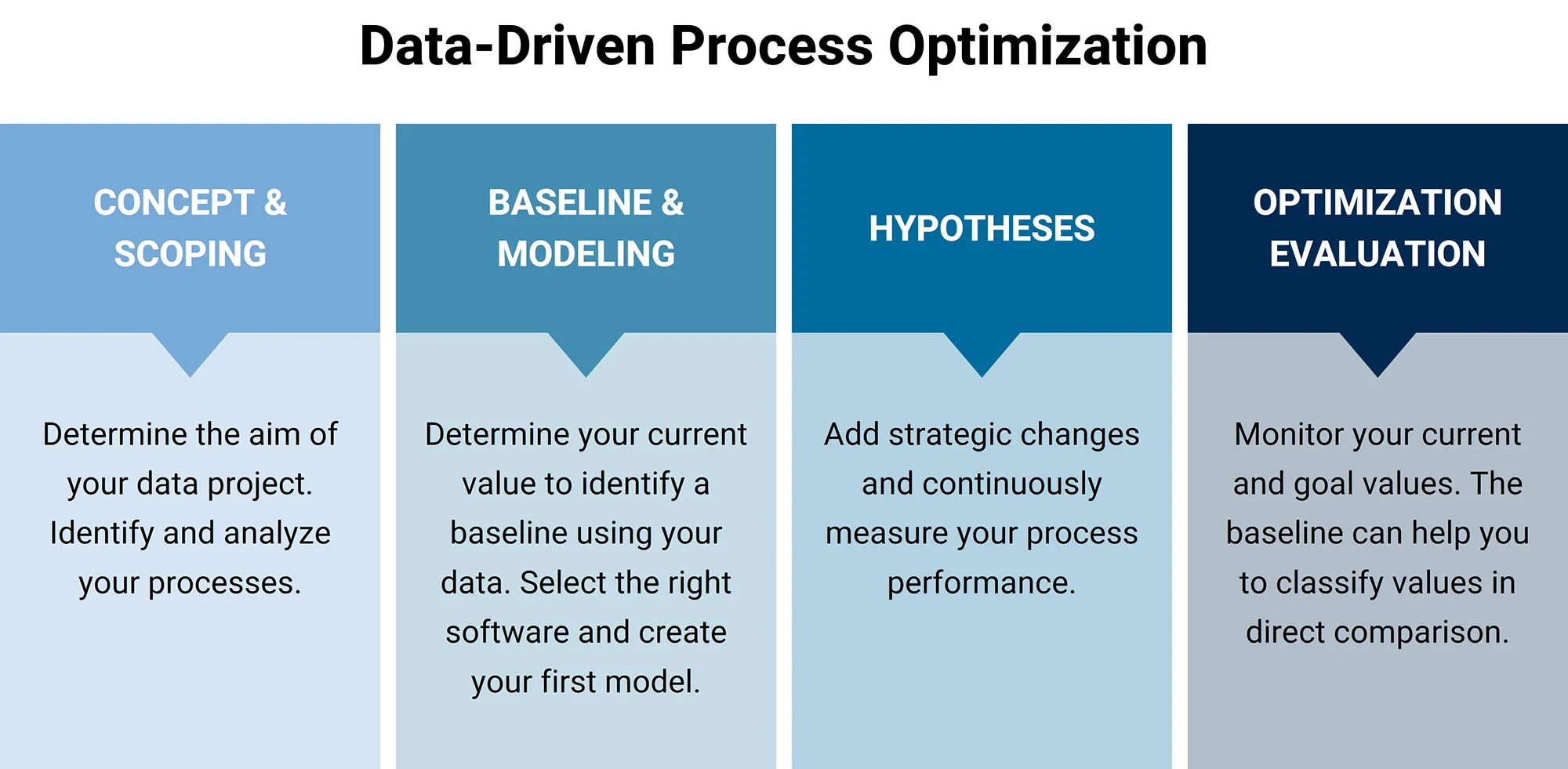
Develop a Concept and Scope by Analyzing your Existing Processes
Start your project by determining what you want to achieve with changes to existing process, which goals are realistically attainable and where your organization currently sits on the journey to becoming data-driven. This is also the moment to take stock of the data which exists in your company. It is worth getting in touch with us at this stage: suitable data drastically increases the value of any analytics project! Make a list of the everyday challenges you face and why you want to deal with them.
- What consequences will there be for you and your company if these issues are not addressed?
- What do you want to gain or save by achieving a certain goal?
- Are some goals dependent on others? Is there an order of priority?
These questions help you define what’s relevant to your project and how to prioritize. Next, analyze where problems actually occur. Which processes deviate from the current state? Really delve into this and ask yourself e.g.: Does a process keep deviating from the defined workflow and why does this happen? Identifying these processes is crucial for the next step. The next step involves analyzing your processes in detail step-by-step. Based on this, you can then get going: Document your exact requirements for your business data analytics project, define initial KPIs and formulate hypotheses about where optimization potential exists. This is also a good time to reflect on your data situation: are all sources available and of sufficient quality for the KPIs you want?
Establish your Baseline and Start Modeling & Experimenting
Define a baseline and set up tracking of process performance. The baseline is derived from the current values of your process. It is important to document the individual key indicators that will enable an objective decision base which can be clearly measured. These key indicators can be used to carry out the analysis necessary for explaining behavior patterns. You should scrutinize the process with regards to two types of modeling: modeling a data system and statistical modeling of data.
- For data modeling, you should depict the respective data sources and their logical and physical relationships.
- For statistical modeling, you should analyze data quality and data properties as well as uncover latent patterns for better insights and to enable data-based decisions.
Our tip: conduct in-depth interviews with all process stakeholders. These conversations reveal critical context about key indicators and data structures that need to be taken into consideration for statistical modeling. Software tools are essential for both types of modeling. You can easily model your data systems using a powerful tool such as Innovator.
Test your Hypotheses using Your Model and the Right Metrics
You need to make strategic organizational and technical changes when optimizing processes and measure process performance continuously. Continuous use of business analysis can help when discussing change options with decision-makers. Look at the advantages and disadvantages of the solution options, document the chosen path and roll out the respective implementation.
For sustainable change, operational teams must be enabled technically, methodologically and culturally (in the sense of change management) to document and process metrics correctly so they can be used for further assessment. That way you can safely test potential process changes and refine them if unexpected side effects occur. Measure success against the KPIs you defined and based on the metrics selected. Documentation, reporting and visualizing progress using dashboards make it easy to classify process optimization.
Evaluate Process Optimization by Measuring Your Success
Your initial baseline plus continuous tracking allow you to monitor target vs. actual KPIs throughout the change process. This enables objective assessments of the process to be made. The first assessment basis helps you to map the initial defined baseline, this shows your current value with no optimization.
Once optimization has occurred, tracking can then provide an objective comparison of the changes implemented in the processes, both regarding performance and also over the course of time. Because organizations and processes are dynamic, continuous monitoring is key. Tracking not only shows success but also flags significant deviations that may trigger investigations or new requirements; these can then lead to further changes to the process.
This iterative approach gives you a repeatable cycle for requirements analysis and evaluation for your business data analytics project. You analyze all optimizations step-by-step in a structured and traceable way and create the updated data foundation for future changes. What are you waiting for? Get started with your own business data analytics project!
Our third and final part in our business data analytics series will let you into the secrets behind decision intelligence. Keep waiting and you’ll soon find out what you need to bare in mind when making complex decisions for your company and how to successfully automate these decisions.
Do you need expert support with your Business Data Analytics project?
Discover our Data Analytics portfolio and have a no‑obligation chat with our data experts. Together we’ll uncover the opportunities in your business and data to help you optimize your processes more strategically.