
Why should companies care about their processes? Everything’s OK, isn’t it? There are many reasons to start a BPM project. Triggers range from typical growing pains and noticeable drops in productivity or quality to regulatory requirements, low customer satisfaction, unclear internal communication or the lack of a competitive edge. But before you dive into a BPM project, it’s important for everyone involved to understand what BPM actually is and what it can do for your organization. In this blog post, we’ll give you a clear overview of business process management (BPM) and explain why BPM should be an essential part of your company. You’ll learn more about the following BPM topics:
- What is business process management?
- Why choose business process management?
- How BPM enables a process-oriented organization
- The phases of business process management
- Conclusion – Do I really need business process management?
What is Business Process Management?
A business process is a logical sequence of activities within the company designed to achieve a company’s goals. The Association of Business Process Management Professionals International (ABPMP) defines BPM in the “Guide to the Business Process Management Common Body of Knowledge (BPM CBOK)®” as follows:
“Business Process Management (BPM) is a disciplined approach to identifying, designing, executing, documenting, measuring, monitoring and controlling both automated and non-automated business processes to achieve consistent, targeted results aligned with an organization’s strategic goals. […] BPM enables an organization to align its business processes with its business strategy, driving overall performance by improving specific work activities within a department, across the enterprise or between organizations.”
In addition to internal factors, such as organizational conditions and work instructions, BPM must also consider external factors, such as customers, suppliers, legal requirements and market conditions.
Why Choose Business Process Management?
In our consulting work, we often encounter BPM projects that are heavily documentation-driven and usually accompanied by tight time lines and unclear requirements. Many companies want to ascertain what the current state of their processes is. However, we strongly recommend not jumping straight into documentation or business process modeling without a clear concept of the aim of your BPM project. The following BPM aspects can help you shape these objectives:
- Business transformation
- Operational excellence
- Governance, risk and compliance
Business transformation drivers can vary widely, often reflecting strategic shifts. This may be entering new markets, shorter product lifecycles or rising customer expectations. Operational excellence shows companies that they have to improve their workflows. Implementing operational excellence is often supported by the continuous improvement process (CIP). Governance, risk and compliance also provide another aspect. Regulatory requirements must be implemented. Clearly define the value BPM should provide for your company when defining what you want to achieve with BPM.
How BPM Enables a Process-Oriented Organization
Company-wide BPM helps create a process-oriented organization and breaks down barriers formed by traditional organizational structures. Thinking in processes strengthens cross-departmental communication.
The Phases of Business Process Management
The BPM Lifecycle: A Structured Approach to Process Optimization
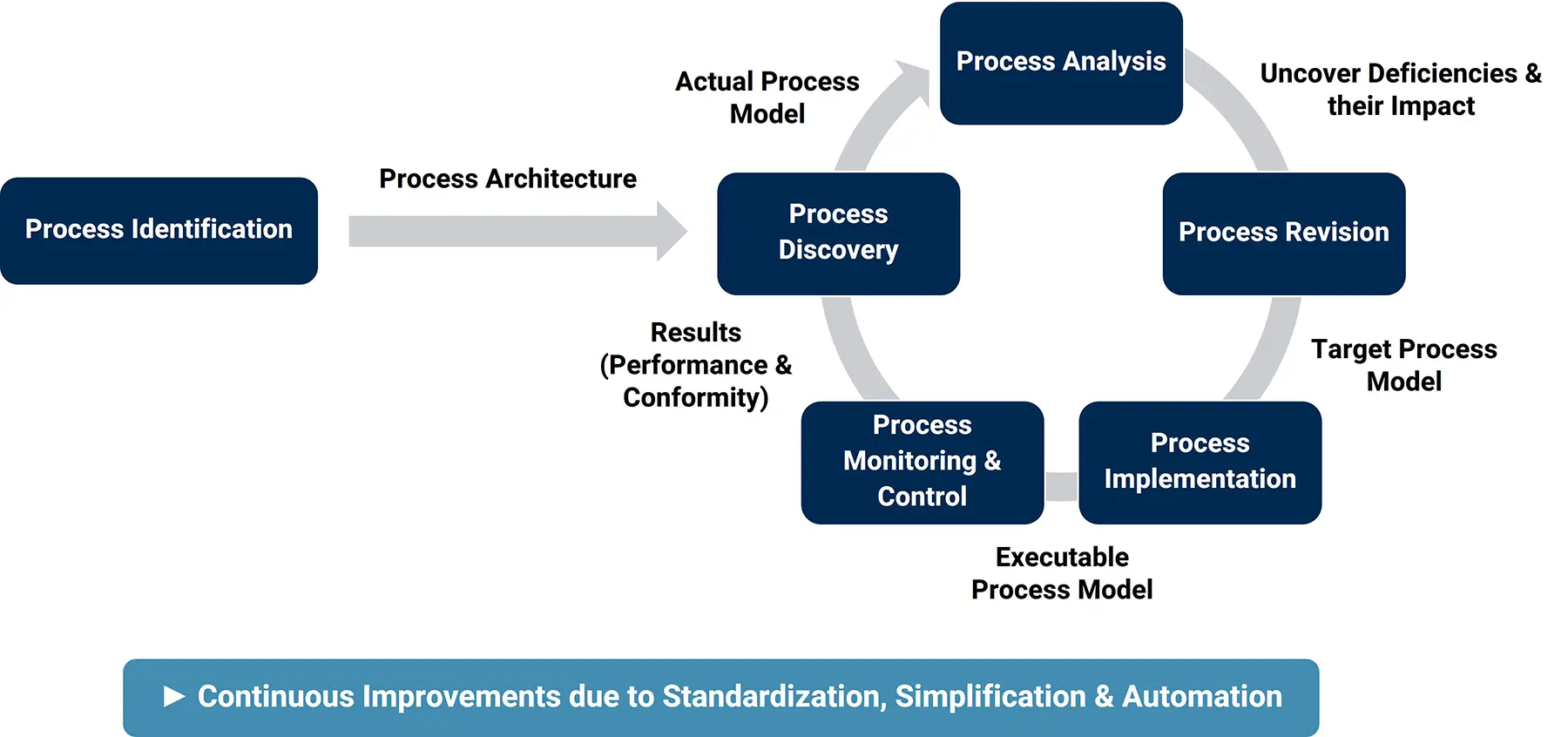
The BPM lifecycle provides a structured method for managing and continuously improving business processes. It consists of multiple phases; from initial process identification right the way through to process monitoring.
Process Identification
In the first phase, the organization identifies and prioritizes the relevant business processes. The problematic area which triggered the BPM project defines the areas which need to be observed. It is essential to define the right scope and level of detail. A company-wide perspective requires a higher-level “bird’s-eye view” than simply analyzing a single area. The goal is to identify processes that are critical to addressing the problematic area. The outcome of this process identification is a new or updated process architecture. This architecture serves as a framework for all subsequent phases of the BPM lifecycle and remains valid until fundamental parameters such as business strategy, market conditions or legal requirements change.
Process Discovery
In this phase, the identified processes are documented using suitable data collection methods and modeling notations such as BPMN. Consistent modeling standards ensure that the resulting current process models are comparable, coherent and consistent. The result of process discovery is verified current process models that have been reviewed and approved by key process participants. These models form the foundation for the next phases in the BPM lifecycle.
Process Analysis
The documented processes are analyzed in this phase to establish a solid basis for future decisions. Key indicators, data analysis and other methods are used to address the problematic area of the PBM project and provide the necessary data foundation. The results reveal process weaknesses and inefficiencies, as well as improvement opportunities. In some cases, the analysis may show that a process is already performing optimally. In such situations, the workflow moves directly to process monitoring — the next process is waiting!
Process Revision
The processes are revised or optimized together with relevant stakeholders based on analysis results. Involving those impacted by the changes is essential to ensure acceptance and support for the future implementation. The outcome is one or more target process models that reflect different stakeholder perspectives, e.g. those of the specialist departments and IT. These models serve as the basis for implementation.
Process Implementation
In the implementation phase, the target process models are transferred into day-to-day operations. Depending on the solution, implementation may range from simple employee training to extensive IT projects aimed at automating processes. The outcome is transforming the target state into a current process model.
Process Monitoring and Control
After implementation, processes are continuously monitored to evaluate the predefined process key indicators. These key indicators were defined in earlier phases and serve to validate the effects and goal achievement of the BPM project using measurable facts and figures. If deviations or problems are discovered during monitoring, the lifecycle starts again. Depending on the situation, this may involve renewed process discovery or directly returning to process analysis based on the facts and figures.
Sustainable Implementation of the BPM Lifecycle
The main goal of your initial BPM project should be to anchor the BPM lifecycle for the long-term within your organization. This ensures that business processes are continuously improved and adapted to new challenges.
Conclusion – Do I Really Need Business Process Management?
Take the time to understand why BPM is the right approach to improving your organization and the people within it in the long term. BPM not only increases process efficiency, it also creates transparency and enables continuous improvement across your processes and, ultimately, your entire organization. Ready to Kickstart Your BPM Journey? We’re here to help you roll out BPM and bring it to life for the long-term within your company. Discover our intuitive BPM tool Bpanda and try it free for 30 days or learn how we can support your BPM project.