
Are you working with Scrum and feel like recurring problems remain unsolved, even with retrospectives and Kanban boards? That’s exactly the conclusion I reached in my first blog post. As a solution for myself and MID, I discovered the “PopcornFlow” method by Claudio Perrone. In this second part of my blog series, I’ll show you exactly how PopcornFlow, as an agile method for continuous improvement, can make your Scrum team more sustainable and efficient.
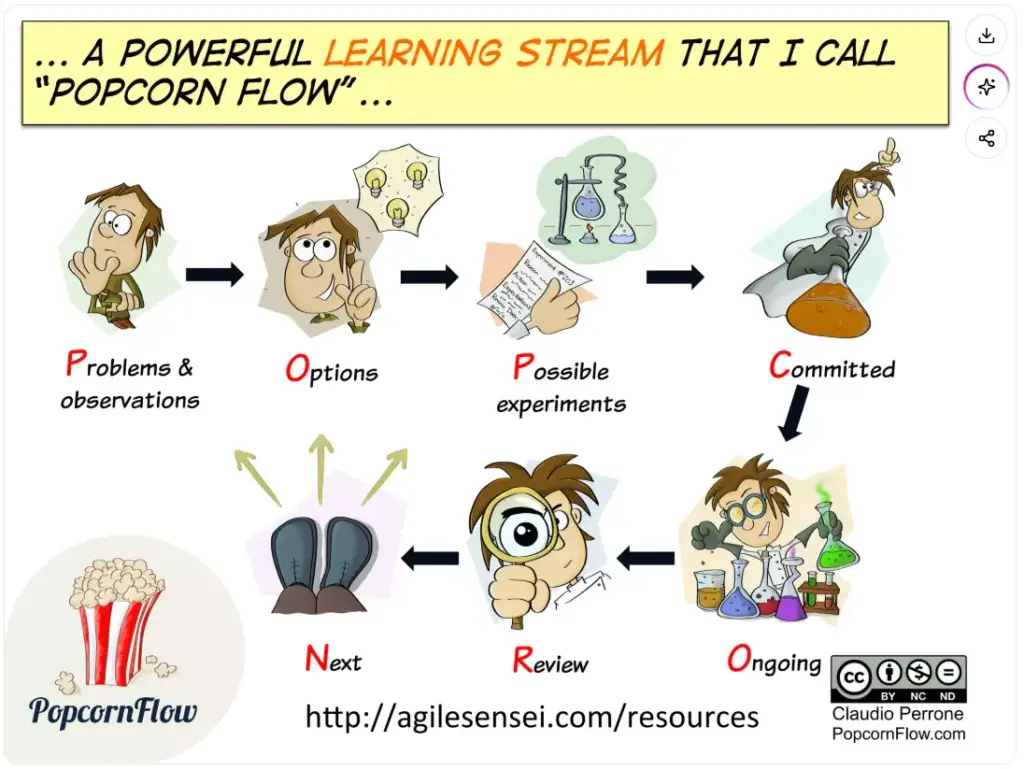
PopcornFlow is a lightweight yet powerful approach to making continuous improvement a reality in Scrum teams. Instead of tackling change as a large, cumbersome project, you break it down into small, manageable steps – following the principle: “If change is hard, make it continuous.”
With PopcornFlow, you respond flexibly and quickly to everyday challenges, boosting the efficiency of your agile team. This makes PopcornFlow the perfect complement to classic retrospectives because you don’t let improvement ideas fizzle out. Instead, you test and evaluate them in a continuous flow.
How PopcornFlow Works in Day-to-Day Scrum
Every topic starts with an Observation. This could be an acute problem or a noticeable trend. The important thing: Every observation is valuable, even if it is not fully understood in detail yet. Just voicing the observation will trigger a thought process in your Scrum team and prompt a deeper look at the issue.
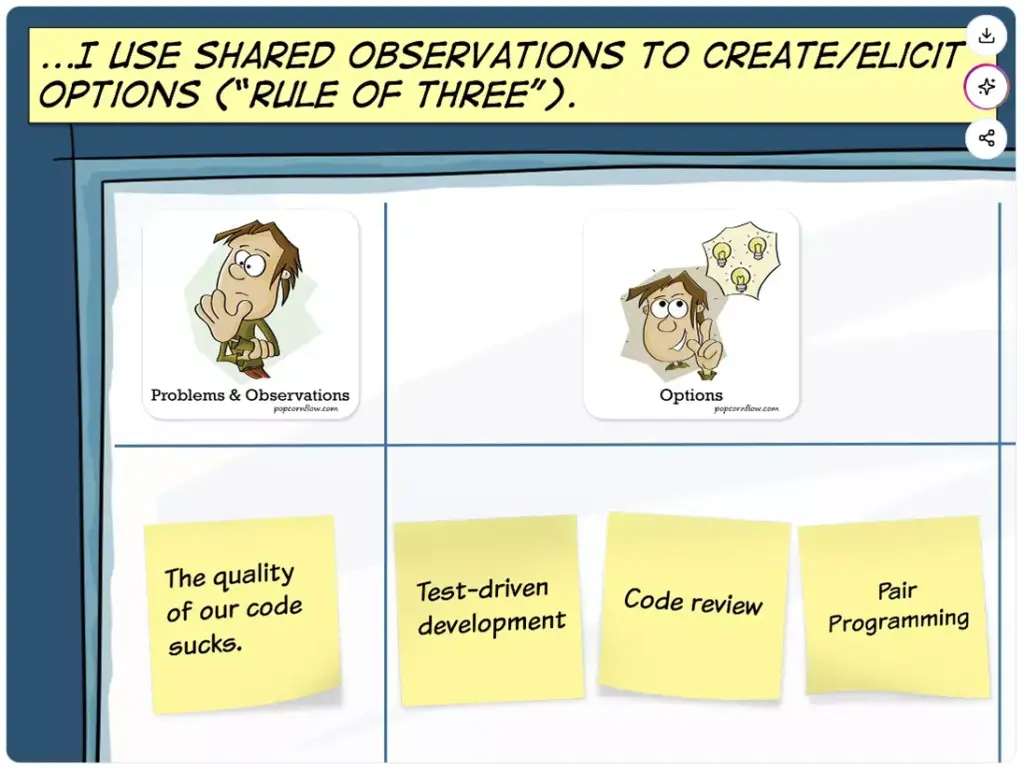
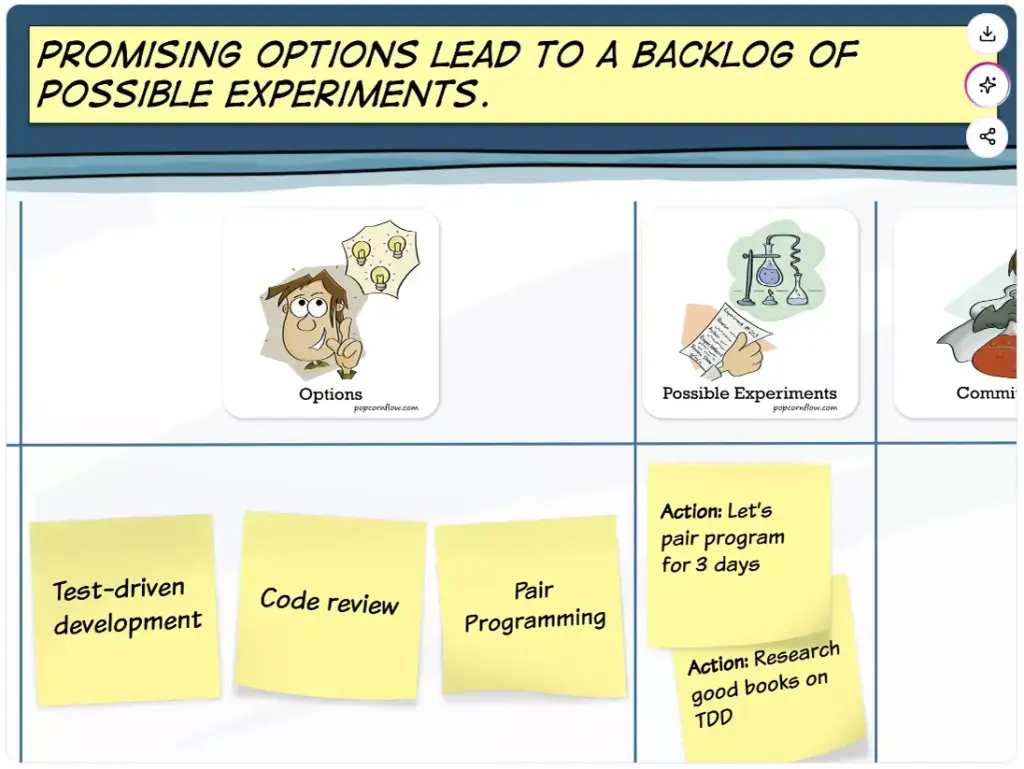
Next, you and your team develop possible Options, potential solutions to the problem. These options are collected as short bullet points. Often, you’ll have several options, some of which may be contradictory. So, you and your team will then evaluate the alternatives and choose at least one Possible Experiment, a promising experiment you want to try out.
This way, you are continuously gaining hands-on experience and insights. At this stage, you can already further refine and specify your options. The result is a backlog of possible experiments, made up of the most promising options.
Once you select a Possible Experiment, it becomes a Committed Tas, the team commits to implementing this option. It’s important to record exactly what the action is, the reasons for it, your expected outcomes or goals, and the timeframe (timebox) or a concrete date for review. If the Committed Task will be carried out by a subset of the team, it helps to note who is responsible.
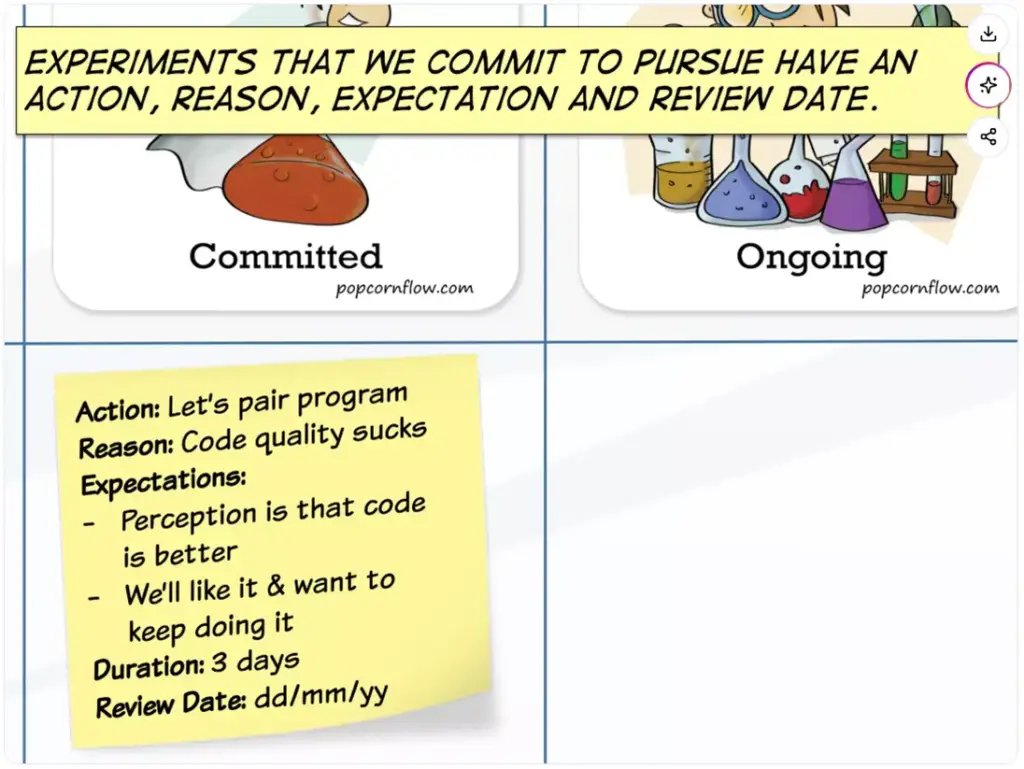
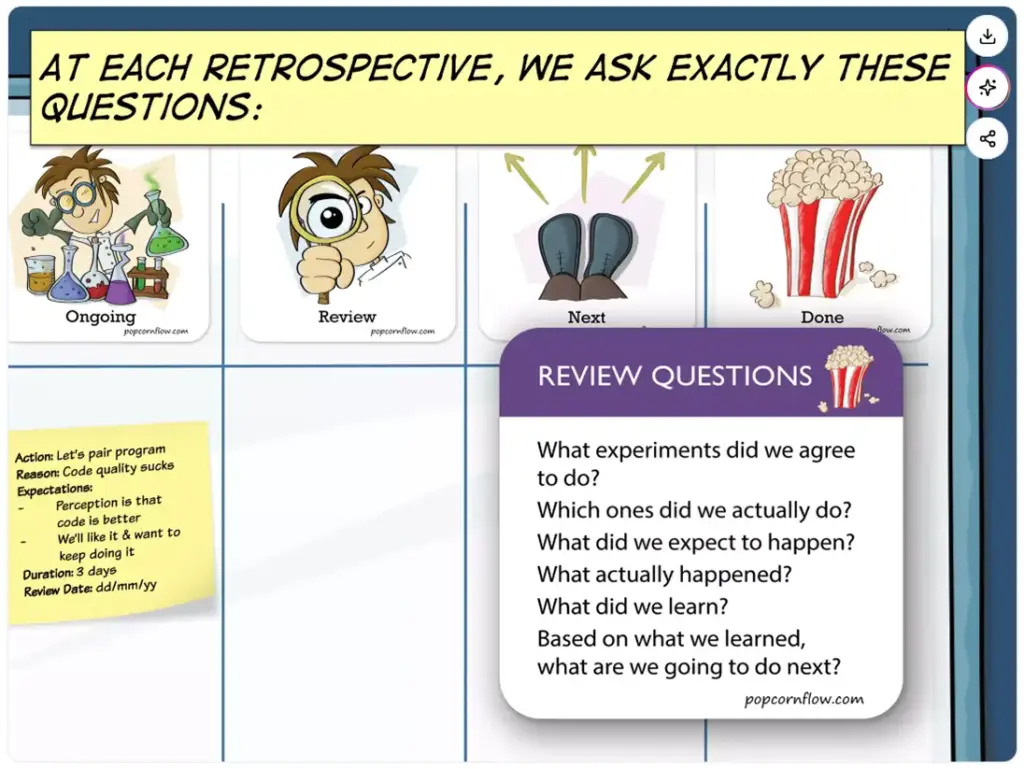
As soon as a Committed Task is being worked on, its status changes to Ongoing, and after completion, to Review. During the Review, you answer the following questions:
- Which experiments did we plan to run?
- Which experiments did we actually run?
- What outcomes did we expect?
- What came true, and what did not?
- What did we learn from this?
- What will we do next?
If the results meet your expectations, the underlying problem is solved. Here’s an important point: The “hoped-for” outcome doesn’t always happen. Sometimes not at all, sometimes only in part. But even failed experiments are valuable. They move you and your team forward, letting you quickly pivot and try something new. This is exactly what makes PopcornFlow so effective for continuous improvement.
Visualizing and Implementing with the PopcornFlow Board
In everyday agile work, you use a PopcornFlow board with eight columns to clearly map each status:
- Problems & Observations
- Options
- Possible Experiments
- Committed
- Ongoing
- Review
- Next
- Done
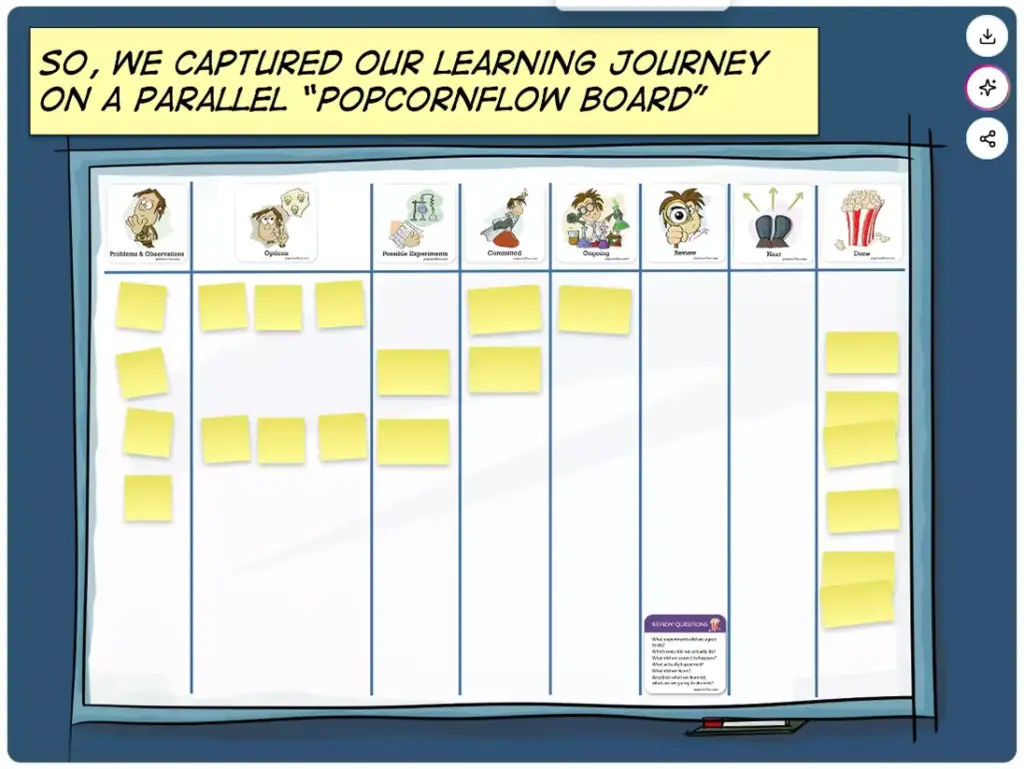
New observations are entered as post-its on your board, and each subsequent step is captured in the same way. Once a problem is solved, you clear the row or move it to documentation as a “Lesson Learned.” Thanks to the transparent board, every Scrum team member can see exactly how improvement processes are progressing.
To seamlessly integrate PopcornFlow into daily work, I extended my Daily Scrum from 15 to 30 minutes: First we hold the Daily, then the Scrum team works directly on the PopcornFlow board. That way, your team does not need an extra meeting in an already packed calendar—and you can easily shift between Daily topics and continuous improvements.
Conclusion: Bring Continuous Improvement to Life in Your Scrum Team with PopcornFlow
PopcornFlow doesn’t replace your Scrum retrospective but greatly expands your team’s capabilities. Even smaller or less urgent problems are still addressed. Lower-priority topics that arise during the sprint are not forgotten, they’re tracked in PopcornFlow and discussed in the next retrospective when relevant.
This way, many problems are communicated and resolved quickly, efficiently, and transparently. PopcornFlow is the perfect support for your continuous improvement process. Your Scrum team becomes more agile, more focused, and achieves visible results even faster. Try PopcornFlow in your own Scrum team today!
Source: Popcorn Theory: https://www.slideshare.net/cperrone/popcornflow-continuous-evolution-through-ultrarapid-experimentation
Are you looking for professional support in your agile product development project?
Then get in touch with us now and find out how our Scrum teams can help with your upcoming project. Discover MID’s Agile Services now!