
AI agents are center stage in 2025 when it comes to digital transformation and are widely regarded as a key technology for companies who wish to stay ahead of the competition. Unlike traditional AI tools such as chatbots or rule-based automation solutions, these systems act autonomously — they don’t just analyze data, they also initiate processes on their own. This opens up entirely new possibilities for making business processes more flexible, quicker and future-proof.
What Makes AI Agents so Special?
While conventional automation solutions rely on rigid rule sets, AI agents can learn from new situations and dynamically adapt their behavior. You can use AI agents so that your processes are efficiently working 24/7, optimize your processes to reduce costs and enable true hyper-personalization in customer interactions; all this can be done individually in real time.
Of course, adopting AI agents comes with challenges. Integrating them into existing systems can be complex and requires careful planning. Data protection and IT security should also be taken into consideration from the very beginning. But the benefits far outweigh the effort: Organizations that adopt AI agents early can leverage the full potential of advanced AI to create strategic advantages, improvements and measurable business value.
How do AI Agents Work?
Unlike simple digital assistants that follow set workflows and execute tasks based on prefedined rules, AI agents can make independent decisions and respond flexibly to new situations. Their “brain” is made up of large language models (LLMs) which understands complex relationships and can make context-dependent decisions.
The core architecture of an AI agent can be summarized in three steps:
- Perception: The agent gathers data from various sources — from customer interactions and IoT sensors, right the way through to ERP systems.
- Processing: The collected information is passed to the LLM via the agents. The LLM processes the data using prompt templates and accesses stored memory and external tools.
- Action: The selected strategy is carried out automatically, either by generating natural language responses or through API integrations with external systems and services. These actions enable the agent to interact directly with its environment and deliver tangible results.
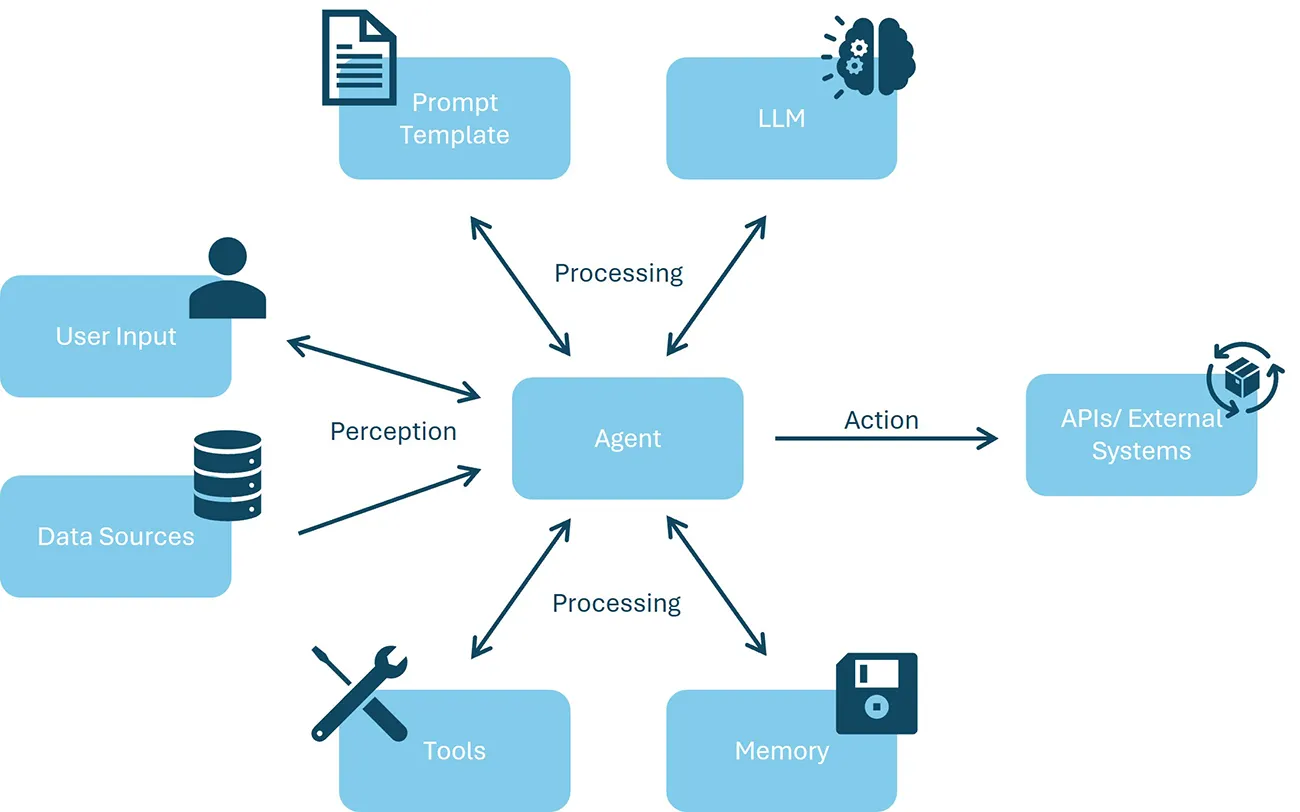
AI agent core architecture
Where AI Agents Deliver Real Business Value
AI agents are no longer a remote dream of what could be — they are already revolutionizing a wide range of business areas today. Multi-agent systems are often used in particularly complex scenarios: coordinated teams of AI agents work together and get to grips with even the most demanding processes. Below are several examples of how AI agents can help you unlock measurable competitive advantages:
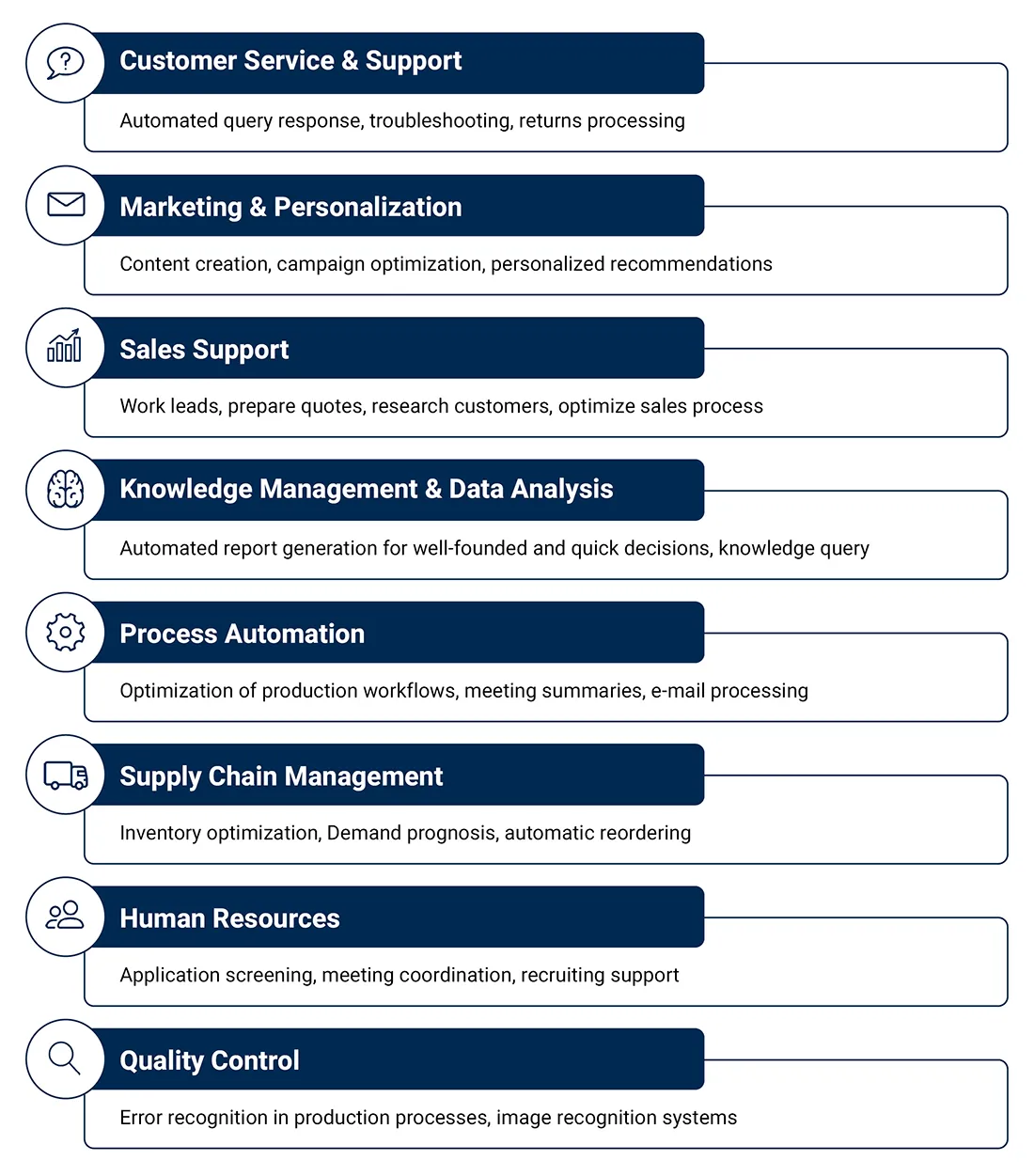
AI agent use cases
From Theory to Practice: MIRA as Use Case
Our use case MIRA in the area of knowledge management will show you precisely how AI agents can support you in your day-to-day business. In modern organizations, the volume of structured information is growing rapidly, e.g. highly complex models created in modeling platforms such as our Innovator. These models include a wide range of diagrams, requirements, processes and their relationships — a valuable data treasure trove that is often so complex that it requires specialist expertise to fully understand and extract knowledge from. For new or non-technical users in particular, finding the right information can be challenging. All the clicking through until you find what you’re looking for is often time-consuming, especially when there are lots of transitive relationships in the model. You can often feel like you are working with one arm tied behind your back and are wasting valuable time.
This is exactly where our use case MIRA (Modeling & Intelligent Reasoning Assistant) comes into play. Our aim: To enable every user to access all model information quickly and efficiently using natural language, regardless of their prior knowledge. Questions such as “Which requirements are linked to process X?” or “How does a change in a requirement impact connected processes and systems?” are answered instantly, without needing to manually search the model structure. The AI assistant understands both individual content and complex relationships within the model. Our approach is also flexible: It can be applied not only to Innovator, but to any type of linked data.
Agentic GraphRAG: Where Intelligent AI Meets Graph Data
We leverage the power of Agentic GraphRAG to enable intelligent model queries. An AI agent is powered by a large language model (LLM) and independently searches through Innovator’s graph-based data. The agent decides autonomously to what extent the graph needs to be searched through to retrieve the right information.
Traditional retrieval methods rely mostly on unstructured text information and similarity searches, meaning they struggle when it comes to deep, multi-level relationships. GraphRAG, on the other hand, works with knowledge graphs, where entities and their relationships are explicitly mapped. This allows an AI agent to search multiple layers of relationships and uncover complex relationships — a major advantage when it comes to model queries.
All data and relationships from the Innovator model are transferred into a graph database (e.g. Neo4j) via our Data Bridge. The AI agent then accesses these graphs to intelligently search and evaluate the entire model structure. The result? A drastic reduction in model landscape complexity for the user: You no longer need to spend ages on manual research; with MIRA, you only need to ask one direct question and then you get the relevant, context-specific answer.
MIRA for Innovator: Real Value for Business Users
With MIRA, you can now use AI to tap into the full innovative power that the Innovator model has to offer. Your benefits:
- Fast, intuitive knowledge queries: You can search models using natural language with no technical expertise required.
- Transparency and clarity: Complex relationships and dependencies are discovered and shown in an easy to understand way.
- Boosted efficiency: Eliminate time-consuming manual searches and make well-founded decisions faster.
- Future assurance: By combining modeling, graph databases and AI agents, your company is fully-equipped for a data-driven future.
Conclusion: AI Agents – Practical Impact Today, Powerful Potential Tomorrow
The MIRA use case shows how modern AI agents can make complex data landscapes accessible to users, regardless of their previous knowledge or technical expertise. MIRA is only one example of the versatility of agent-based AI solutions. The real strength of AI agents lies in their flexibility: you can apply them across a wide range of business processes and data sources — from modeling tools and IT systems to customer service, supply chain, compliance and far beyond.
Our experience at MID: With the right methods and technical approach, AI agents can be tailored to fit the unique challenges of different industries, always with one goal:
creating genuine value for daily work, efficiency and long-term competitiveness. MIRA in Innovator is one example of how we are shaping this transformation.
Ready to Unlock the Potential of AI Agents in your Company?
Whether you’re just starting to develop ideas or looking to implement concrete use cases right away, we’re here to help you integrate AI solutions like our MIRA agent seamlessly into your processes. Benefit from our experience supporting medium-sized businesses with AI solution integration — and free up valuable time for your team.
Try our interactive AI Self Check directly on our website to quickly assess how well your company is prepared for AI roll out. Or use the MID AI Compass to work with us in analyzing your AI maturity, identifying suitable use cases and developing a tailored roadmap for your digital transformation — fully aligned with all relevant regulations, including the EU AI Act.
Talk to our experts! In a non-binding initial consultation, you’ll learn how AI can take your workflows to the next level — tailored to your unique challenges. Together, we’ll determine which options make sense for your organization and how to successfully integrate AI into your systems.
Get in touch today and take the first step into an agent-powered future!